
The critical fact about diabetic eye disease is that it progresses without symptoms in its early stages. By the time you notice changes in your vision, the damage may be advanced and harder to treat. That is why annual diabetic eye exams are not optional. They are essential. At Chinook Eye Center, Dr. Perez performs detailed retinal evaluations specifically designed to catch diabetic changes at the earliest possible stage, when treatment is most effective and vision loss can be prevented.
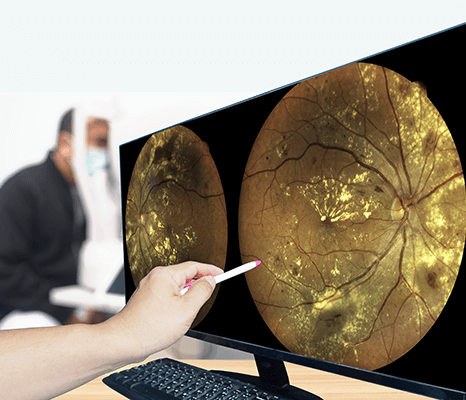
A standard eye exam checks your prescription and overall eye health. A diabetic eye exam goes deeper, with particular focus on the retinal vasculature, the network of blood vessels that feeds your retina. Dr. Perez is specifically looking for:
Diabetes accelerates cataract formation, often causing cataracts to develop earlier and progress faster than in non-diabetic patients.
Diabetes roughly doubles your risk of developing open-angle glaucoma. Dr. Perez monitors your intraocular pressure at every diabetic eye exam.
Using the iCare tonometer, Dr. Perez measures your intraocular pressure with a gentle, brief contact , no puff of air. Elevated eye pressure is a key risk factor for glaucoma, and routine measurement is essential for early detection.
Measures your current functional vision to detect any changes since your last examination.
Gentle, puff-free eye pressure measurement to screen for glaucoma risk.
The American Diabetes Association recommends a comprehensive dilated or retinal-imaged eye exam at least once per year for all patients with Type 1 or Type 2 diabetes. If Dr. Perez identifies early signs of retinopathy, he may recommend more frequent monitoring, every six months or even quarterly, to track progression closely.
With your permission, Dr. Perez can share your retinal imaging results and exam findings with your primary care provider or endocrinologist. Diabetic eye care works best when your eye doctor and your diabetes management team are communicating. If Dr. Perez identifies retinal changes that require treatment beyond what we provide, such as anti-VEGF injections or laser therapy, he will refer you to a trusted retinal specialist.
If you have diabetes and have not had an eye exam in the past year, call Chinook Eye Center at (406) 357-3740 today. Early detection is the most powerful tool we have for protecting your vision.